

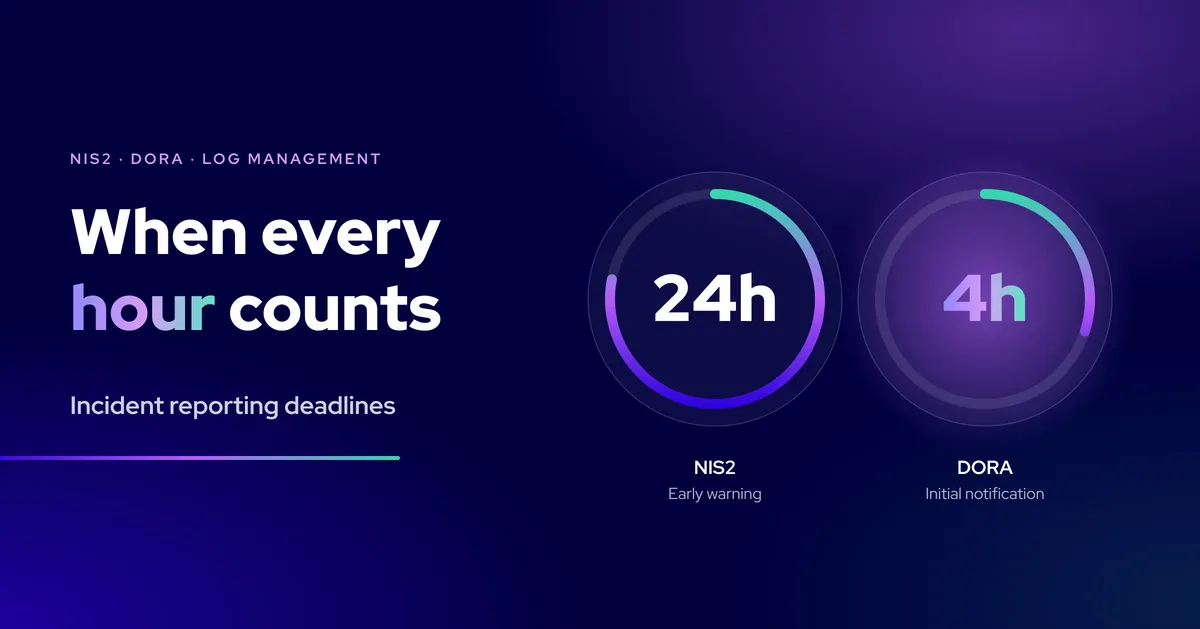
NIS2 and DORA reporting deadlines can begin within hours of an incident: 24 hours, 72 hours, and one month under NIS2, and an even tighter timeline under DORA, where an initial notification can be due within 4 hours of classifying a major incident. This article outlines what each framework requires and when the clock starts. It also explains how to organize your log management so you don’t lose precious hours when every minute counts.
NIS2: From NIS1 to a Far More Structured Reporting Framework
The NIS2 Directive (EU) 2022/2555 replaces the first NIS Directive adopted in 2016. It significantly broadens the range of organizations in scope and strengthens their obligations, particularly for risk management and for reporting significant incidents.
NIS2 and DORA take a functional view of incidents: they cover any event that compromises the availability, authenticity, integrity, or confidentiality of systems, data, or services. Depending on its impact and classification under the applicable framework, an infrastructure outage or a configuration error can therefore trigger a reporting obligation, just like an intrusion.
What Are the NIS2 Reporting Deadlines?
For significant incidents, NIS2 Article 23 structures reporting around three main milestones.
| Deadline | What is expected |
|---|---|
| Within 24 hours | Early warning to the CSIRT or competent authority, including whether the incident may be malicious or have a cross-border impact. |
| Within 72 hours | Incident notification, updating the early warning with an initial assessment of the incident’s severity and impact and, where available, indicators of compromise. |
| Within 1 month of the incident notification | Final report detailing, among other things, the incident, its severity, its root cause, and the measures taken. |
Key takeaway: Under NIS2, the clock starts when you become aware of an incident, not when you resolve it.
DORA: Tighter Deadlines for Major ICT-Related Incidents
DORA (Regulation (EU) 2022/2554) specifically addresses the digital operational resilience of the financial sector and has applied directly since January 17, 2025. For incident management, it sets out a framework for classifying and reporting incidents to the competent authorities.
For a major ICT-related incident, you must notify within 4 hours of classification. The 24-hour deadline starts when you become aware of the incident, so delaying classification does not buy you time.
How Do NIS2 and DORA Reporting Deadlines Differ?
| NIS2 | DORA | |
|---|---|---|
| Incident type | Significant incident | Major ICT-related incident |
| First milestone | Early warning within 24 h | Initial notification within 4 h of classification, and no later than 24 h after becoming aware of the incident |
| Second milestone | Incident notification within 72 h | Intermediate report within 72 h of the initial notification |
| Final report | Within 1 month of the incident notification | Within 1 month of the intermediate report or the latest updated report |
Detection Is Not Investigation
Detection identifies that something abnormal is happening. Depending on the issue, different tools come into play. For example, infrastructure and application monitoring can detect an outage, performance degradation, or saturation. Intrusion, data exfiltration, or unauthorized access is more the domain of specialized cybersecurity tools such as SIEM, EDR/XDR, or threat intelligence.
Investigation comes next. Your team must identify the events, date them, cross-reference multiple sources, understand how they unfolded, and rely on data whose integrity it can establish.
Logs therefore do not replace IT monitoring or security detection tools. They are the raw material for reconstructing the facts once an alert has fired.
Why Do NIS2 and DORA Deadlines Make Log Centralization Essential?
Imagine an incident starts at 9:00 a.m. An alert comes in.
You need to determine which applications are affected, find the first event, identify the equipment involved, understand the sequence of events, assess the consequences, and prepare the information required for the notification.
If your logs are scattered across servers, network devices, applications, and several cloud environments, your team has to hunt for the data before the analysis can even begin.
Three log management capabilities then become decisive for meeting regulatory deadlines: centralization, fast searching, and correlation.
Centralize to Stop Wasting Time Searching
A centralized platform gives you a single point of access to the data needed for analysis. The goal is not simply to “store logs,” but to be able to use them the moment an incident occurs. With centralized logs, your team can go straight to searching for them.
Search Your History Quickly
The amount of data you retain is not, on its own, a measure of readiness. The real question is: how long does it take to find the information that matters?
In Centreon Log Management, the Log Explorer lets you search and filter logs to investigate incidents and identify their root causes.
Correlate to Rebuild the Timeline
A first anomaly may appear on a device, be followed by application errors, then cause an outage that shows up in monitoring.
Taken in isolation, each of these events tells only part of the story, and none gives you the full picture. Correlating them lets you rebuild a timeline: first signal, spread, systems affected, impact, and return to normal.
Key takeaway: The real challenge is no longer just keeping logs but using them within the regulatory deadline.
Reliable Logs Produce Reliable Information
Speed is necessary, but it is not sufficient. To reconstruct the facts accurately, you also need logs you can rely on. That means, in particular, appropriate retention, protection against tampering or deletion, access control, and consistent timestamps.
That last point is especially important. When records come from several systems, correlating them requires synchronized clocks. Two perfectly accurate logs can become hard to match if their time references differ.
Can You Gather This Information Within 24 Hours?
We recommend running a dry run and timing how long it takes to gather the required information. Take a hypothetical incident and check whether your team can:
- Precisely date the first sign of the incident from your logs
- Quickly identify the systems and data affected
- Rebuild a timeline by cross-referencing several sources
- Access a deep enough history when an incident is detected late
- Produce a usable export or report
- Identify, without hesitation, who must report the incident, to which authority, and by when
Centreon Log Management: From Alert to Explanation, Faster
What speeds up investigation is the way the Centreon platform combines monitoring with log analysis.
The two complement each other: Centreon Infra Monitoring identifies an incident, while Centreon Log Management lets you explore logs to understand what is happening and find the root cause.
Centreon Log Management centralizes logs from multiple sources and lets you analyze them through filters, queries, or dashboards. It includes the capabilities NIS2 and DORA expect: configurable retention, protection against tampering and deletion, role-based access control, encryption, OpenTelemetry-based collection, and correlation with Centreon Infra Monitoring.
Another key compliance point: NIS2 and DORA require you to keep control over the providers that host your logs. Centreon Log Management is built for strategic autonomy, with a European vendor in control of its own value chain and data hosted in the European Union.
Don’t Wait for an Incident to Determine Your True Response Time
NIS2 and DORA introduce a new constraint on incident management: regulatory time does not necessarily align with the technical time teams believe they have.
Once the clock is running, searching for the right files, manually matching events across several systems, or piecing together a timeline after the fact becomes very costly. Preparation therefore begins long before the notification.
Our practical guide, NIS2 & DORA: What EU Regulators Now Expect You to Prove From Your Logs, outlines the requirements for logs, the reporting deadlines, and the steps to prepare your setup.
Download the guide and assess your ability to meet NIS2 and DORA deadlines today.
FAQ: NIS2 and DORA Reporting Deadlines
What Is the NIS2 Incident Reporting Deadline?
For a significant incident, NIS2 requires an early warning within 24 hours of becoming aware of the incident, an incident notification within 72 hours, and a final report within one month of the incident notification. If the incident is still ongoing at that point, a progress report is due before the final report.
What Is the DORA Incident Reporting Deadline?
For a major ICT-related incident, DORA requires an initial notification within 4 hours of classification, and no later than 24 hours after becoming aware of the incident. An intermediate report must follow within 72 hours of the initial notification, and a final report within one month of the intermediate report or the latest updated intermediate report.
Do All IT Incidents Need to Be Reported Under NIS2?
No. The NIS2 Article 23 reporting obligations apply only to significant incidents, so an “IT incident” is not the same as a “reportable incident.” However, an incident that may fall within the regulatory scope is not limited to a cyberattack: an outage or a configuration error can also qualify, depending on its consequences and classification.
Is a Log Management Tool All It Takes to Comply With NIS2 or DORA?
No. NIS2 and DORA impose organizational and regulatory obligations that go far beyond a log management setup. A log management tool, however, supports several capabilities that compliance depends on: centralization, search, correlation, retention, traceability, and fast access to the information an investigation needs.
What Is the Difference Between IT Monitoring and Log Management During an Incident?
They play complementary roles. Infrastructure and application monitoring can detect an outage, saturation, or performance degradation. Log management supports the investigation, letting you find, date, and correlate the events needed to reconstruct the incident.
How Can We Tell Whether Our Organization Can Meet the 24-Hour Deadline?
The most practical approach is to conduct a dry run. Simulate an incident and time how long it takes to identify the first sign, determine the affected systems, correlate the different sources, and produce the information needed for a notification.
How Can Centreon Log Management Help With Incident Management?
Centreon Log Management combines configurable retention, protection against tampering and deletion, role-based access control, encryption, and OpenTelemetry-based collection. Its correlation with Centreon Infra Monitoring also brings infrastructure alerts and application logs together to speed up investigation.
Official sources: NIS2 – Directive (EU) 2022/2555 · DORA – Regulation (EU) 2022/2554 · Delegated Regulation (EU) 2025/301 on major incident reporting
This article is informational and does not constitute legal advice. For compliance decisions, refer to the official texts and the competent authority in your jurisdiction.